Wednesday, July 20, 2011

Grimoires: A History of Magic Books.

Owen Davies. Grimoires: A History of Magic Books. Oxford: Oxford University Press, 2010. 384 pp. $17.95 (paper), ISBN 978-0-19-959004-9.
Reviewed by Adam Jortner (Auburn University)
Published on H-Albion (June, 2011)
Commissioned by Jeffrey R. Wigelsworth

The Magic Words
 
Owen Davies begins his latest history of the uncanny by quoting Richard Kieckhefer’s observation that “‘a book of magic is also a magical book’” (p. 2).[1] A history of grimoires, therefore, must not only recount the contents and ideas found in self-proclaimed spell books, but also uncover how those books were used. Such a problem, however, is one Davies has met in previous works on ghost stories and witchcraft--which also exist both as theories and tools.

Grimoires represents the broadest chronology Davies has yet attempted. Magical books date back almost to the invention of writing; this volume stretches from Moses and the Hebrew Bible to Anton LaVey and The Satanic Bible (1969). Practically, however, the story begins with medieval efforts to appropriate and interpret ancient magic, through the fifteenth-century rise of hermeticism, and into the democratizing effect of the printing press. Davies makes much of the expanded reach print gave to grimoires, and hence most of this account deals with the early modern and modern use of printed magical books by esoteric gentlemen and treasure-seeking rabble alike. Even if, as Davies argues, print did not eliminate handwritten grimoires, the print revolution created more grimoires and more stories about grimoires--the intellectual back and forth and anecdotal evidence that provide the two evidentiary supports of this study.

Rather like a magus himself, Davies weaves telling details from grimoires throughout his narrative, vignettes of magic or advice that convey a sense of the work and the context under consideration. Medieval Christian grimoires often used Hebrew characters in the belief that Hebrew letters had magical properties, and if authors did not know how to write Hebrew, they simply made up letters that looked close enough. Icelandic rune books featured curses that inflicted ceaseless farting on victims. Nineteenth-century American oneiromancy manuals advised those who dreamed of ants to bet on the numbers two, seven, and forty-one.

Davies handles the vast scope of the book well, moving chronologically by chapter and geographically within each era. Britain (and its grimoires) do not figure prominently in the text, perhaps because England seems to have preferred astrological texts to practical spell books. Nevertheless, Davies weaves several English thinkers (Reginald Scot in particular) into the broader debates on magic. Indeed, the scope of Davies’s work suggests that it is in the Americas where the grimoire tradition thrived in the twentieth century. Chicago--the home of William Delaurence’s publishing empire--was the center of grimoire publishing and esoteric practice in the modern age. Kardecism--one of Brazil’s enduring religious traditions--derived from grimoire hermeticism coupled with Spiritualist teachings. Mexico provided a home for Spanish grimoires during the interwar years, which in turn transformed the local healing traditions of curandismo (folk healing). The number of examples and stories from the former colonies of Europe (rather than Europe itself) underscores Davies’s contention that whereas the history of the grimoire in the modern West has often focused on “the esoteric philosophies, personal relations, and internal tensions” of a small number of Western occultists, “certain products of the Revival reached far beyond the parlors of Paris and London” (p. 185).

None of these stories are, in themselves, new discoveries; indeed, almost the entire book is synthetic, as any broad study must be. Certainly as regards Britain in the eighteenth and nineteenth centuries, Davies has debts (which he acknowledges) to Ronald Hutton and Alex Owen. But most readers will search in vain for any extended historiographical quibbling, except for a well-argued aside on the sensitive topic of the grimoire tradition and life of the Mormon prophet Joseph Smith Jr. Grimoires is not necessarily written for the layperson, but neither is Davies writing for academics alone. The book could well form the foundation for an upper-level collegiate class on grimoires and magic. Rather than posit transhistorical theories about “the” nature of magical books, Davies seems content with extensive documentation--but documentation is not explanation.

And yet, if showing the number and influence of magical books in Western history is Davies’s objective, then in showing volume, he makes an implicit argument: fully two-thirds of his world history of grimoires involves books published after the onset of the Enlightenment. The rise of printing, the spread of literacy, and the rediscovery of ancient Near Eastern cultures led to the creation (and re-creation) of many more grimoires in the years since 1700 than had ever before existed. Davies’s nineteenth-century predecessor, Arthur Edward Waite--who wrote an extended history of magic books in addition to designing tarot cards--noted the “remarkable bibliographic fact that such texts were issued, and on so great a scale, in the last decade of the nineteenth century” (p. 181).[2] Seen from the perspective of the grimoire, magic is a thoroughly modern phenomenon--not a survival or a retention.

This latter point represents an important piece of the argument for those who study magic, witchcraft, and esoterica; unlike many other subfields, historians of the supernatural often need to demonstrate the ubiquity and extent of their subject matter to convince colleagues and committees of the validity of their work. Several works in the last decade (some of them by Davies) have shown that magical, mystical, and esoteric thought thrived in the modern age, yet an older sociological predilection still persists that treats magic and miracle as exclusively premodern ideas that existed only as holdovers in the twentieth century. If Grimoires is correct, however, the nineteenth and much of the twentieth centuries provided the ideal environment for magical thinking. Magic is very modern. Other books have made a similar point, but it is a point worth hearing more than once, particularly when written with Davies’s élan.

Note
[1]. Richard Kieckhefer, Forbidden Rites: A Necromancer’s Manual of the Fifteenth Century (University Park: Pennsylvania State University Press, 1997), 4.
[2]. Arthur Edward Waite, Shadows of Life and Thought (London: Selwyn and Blount, 1938), 137.

Ship as Monster

Miniature of Noah’s Ark, Old English Hexateuch (London, British Library, MS. Cotton Claudius B. IV, f. 15v).

Living as they did, at the edge of the inhabitable world, the medieval English were very concerned with limits and boundaries. Their texts and images demonstrate a focus not only on the borders of the earth, of towns, even of individual bodies, but also on the borders of images and pages, which would result in the eventual English efflorescence of visual marginalia. Now, at the final boundary of this text, one frame seems of particular significance. On folio 14r of the Hexateuch—one of the most significant works to survive the Anglo-Saxon period, with approximately 400 images and “one of the first extended projects of translation of the Bible in a European vernacular”—we find an image of Noah’s Ark. Above, God explains to Noah the specifications of the ark. It must be three hundred cubits long, fifty wide and thirty high, with a window at the apex and a door and three decks, all of which are clearly present in the image, below.

This ark is, however, no mere boat. The illuminator has added particular touches that localize the ship, tying it to his own region. From the prow springs a lively dragon-head, with a curling blue mane and its mouth open wide. The stern has been transformed into a broad, flat tail, perhaps more like that of a fish than a dragon. As a result, the whole boat has become animate. Karen Olsen notes that “the depiction of the ship as a beast” in Old English and Old Norse poetry is quite common, with the sea-horse as the most frequently used metaphor. The term more frequently used in the Old English compounds is hengest (horse) which, it will be recalled, was also the name of the mythical founder of Anglo-Saxon England. This visual image, like many others, does not present a sea-horse but rather, a mighty seadragon, though it is somewhat equine in its features.

C. R. Dodwell and Ruth Mellinkoff argue that Scandinavian influences may account for the serpent-head on the ark. Surviving examples of actual Scandinavian ships of the Early Middle Ages feature dragon carvings at their prows, and on separate posts and copper vanes, “decorated with zoomorphic figures, which would also have been set at the ship’s prow.” Dodwell rightly notes that “it needs little perception to see that [the Hexateuch’s] ships, decorated with dragon-heads at the bow and stern, reproduce those used in northern Europe in the 11th century.” Still, Olsen notes regarding animate ships in Old English and Old Norse poetry that while “the Anglo-Saxon scop worked under sociocultural conditions very different from those of the Norse poet . . . of course, sea-travel was an important aspect of Anglo-Saxon society as well.” It ought be recalled that the Anglo-Saxons were, like the Scandinavians with whom they shared much of their mythology, a sea-faring culture. Boats played vital roles not only in their commerce and warfare, but also in their poetic works, such as “The Seafarer” and “The Wanderer,” as well as their spiritual life; boats as burial structures, such as were found at Sutton Hoo, indicate that these vessels were more than simple conveyances to their owners.

Da Vinci Mona Lisa Mystery; Real Secret Codes Discovered

Leonardo Da Vinci’s mysterious Mona Lisa has just gotten even more intriguing. The Italian genius apparently painted tiny numbers and letters into the eyes of the enigmatic painting, but their meaning is unclear.
The 500-year-old Renaissance masterpiece has long puzzled art historians, from Mona Lisa’s wry smile to the identity of the woman in the painting. Some believe it is Da Vinci himself, painted as a woman.
As for Da Vinci, he was a fan of riddles and secret codes and his paintings formed the basis of the best selling fictional work “The Da Vinci Code.”

The book by Dan Brown and the 2006 movie based on it starring Tom Hanks claimed the Mona Lisa contained secrets about the life of Jesus Christ.
The book postulated that Christ had a child with Mary Magadelene and established a blood line that exists to this day.
The real codes in Mona Lisa’s eyes may not be quite so consequential, but they are mystifying, nonetheless, not only for what they may mean, but also because of that fact that Da Vinci was able paint them so small.
The letters and numbers cannot be seen with the naked eye.
Italy’s National Committee for Cultural Heritage said the symbols were detected through high resolution images of the painting.
“To the naked eye the symbols are not visible, but with a magnifying glass they can clearly be seen,” said Committee President Silvano Vinceti.
“In the right eye appear to be the letters LV which could well stand for his name Leonardo Da Vinci, while in the left eye there are also symbols, but they are not as defined,” he said.
“It is very difficult to make them out clearly but they appear to be the letters CE or it could be the letter B. You have to remember the picture is almost 500 years old so it is not as sharp and clear as when first painted,” he added.
In the arch of the bridge in the background the number 72 can be seen or it could be an L and the number 2, he said.
The clue to the codes was found in a 50-year-old book about the painting that was discovered in an antique shop. It mentions the codes and symbols, Vinceti said.
“It’s remarkable that no-one has noticed these symbols before and from the preliminary investigations we have carried out we are confident they are not a mistake and were put there by the artist,” Vinceti said.

Naqsh-e Rustam (Panorama view).

Naqsh-i Rustam (also Naqsh-e Rustam; in English, the Throne of Rustam) was considered a sacred mountain range in the Elamite periods (early first millennium BCE). The façades of Naqsh-i Rustam became the burial site for four Achaemenid rulers and their families in the fifth and fourth centuries BCE, as well as a major center of sacrifice and celebration during the Sasanian period between the third and seventh century CE.

Achaemenid tombs
Four tombs belonging to Achaemenid kings are carved out of the rock face. They are all at a considerable height above the ground.

The tombs are known locally as the 'Persian crosses', after the shape of the facades of the tombs. The site is known as salīb in Arabic, perhaps a corruption of the Persian word chalīpā, "cross". The entrance to each tomb is at the center of each cross, which opens onto to a small chamber, where the king lay in a sarcophagus. The horizontal beam of each of the tomb's facades is believed to be a replica of the entrance of the palace at Persepolis.

One of the tombs is explicitly identified by an accompanying inscription to be the tomb of Darius I the Great (c. 522-486 BC). The other three tombs are believed to be those of Xerxes I (c. 486-465 BC), Artaxerxes I (c. 465-424 BC), and Darius II (c. 423-404 BC) respectively. A fifth unfinished one might be that of Artaxerxes III, who reigned at the longest two years, but is more likely that of Darius III (c. 336-330 BC), last of the Achaemenid dynasts.

The tombs were looted following the conquest of the Achaemenid Empire by Alexander the Great.

Sassanid reliefs
Seven oversized rock reliefs at Naqsh-e Rustam depict monarchs of the Sassanid period.
    The investiture relief of Ardashir I (c. 226-242):
    The founder of the Sassanid Empire is seen being handed the ring of kingship by Ahura Mazda. In the inscription, which also bears the oldest attested use of the term 'Iran' (see "etymology of 'Iran'" for details), Ardashir admits to betraying his pledge to Artabanus IV (the Persians having been a vassal state of the Arsacid Parthians), but legitimizes his action on the grounds that Ahura Mazda had wanted him to do so.
    The triumph of Shapur I (c. 241-272):
    This is the most famous of the Sassanid rock reliefs, and depicts Shapur's victory over two Roman emperors, Valerian and Philip the Arab. A more elaborate version of this rock relief is at Bishapur.
    The "grandee" relief of Bahram II (c. 276-293):
    On each side of the king, who is depicted with an oversized sword, figures face the king. On the left stand five figures, perhaps members of the king's family (three having diadems, suggesting they were royalty). On the right stand three courtiers, one of which may be Kartir. This relief is to the immediate right of the investiture inscription of Ardashir (see above), and partially replaces the much older relief that gives Naqsh-e Rustam its name.
    The two equestrian reliefs of Bahram II (c. 276-293):
    The first equestrian relief, located immediately below the fourth tomb (perhaps that of Darius II), depicts the king battling a mounted Roman soldier.
    The second equestrian relief, located immediately below the tomb of Darius I, is divided into two registers, an upper and a lower one. In the upper register, the king appears to be forcing a Roman enemy from his horse. In the lower register, the king is again battling a mounted Roman soldier.
    Both reliefs depict a dead enemy under the hooves of the king's horse.
    The investiture of Narseh (c. 293-303):
    In this relief, the king is depicted as receiving the ring of kingship from a female figure that is frequently assumed to be the divinity Aredvi Sura Anahita. However, the king is not depicted in a pose that would be expected in the presence of a divinity, and it hence likely that the woman is a relative, perhaps Queen Shapurdokhtak.
    The equestrian relief of Hormizd II (c. 303-309):
    This relief is below tomb 3 (perhaps that of Artaxerxes I) and depicts Hormizd forcing an enemy (perhaps Papak of Armenia) from his horse. Immediately above the relief and below the tomb is a badly damaged relief of what appears to be Shapur II (c. 309-379) accompanied by courtiers.

LINK

LINK

LINK

Volcano - Pyroclastic Surges and Blasts

Risk assessment. An ultimate goal of volcanologists is to minimize loss of life and property from explosive eruptions. Risk assessment, which accounts for both the probability of an event and its consequences, is an important step in attaining that goal. The ability to recognize pyroclastic surge events in the geologic record of a volcano is key in establishing probabilities of surge events. An area that needs particular focus is constraining the effects, or consequences, of pyroclastic surge events. This will involve predicting the dynamic conditions within surges and the responses of structures and people to those conditions.

Glossary

base surge A turbulent density current that flows outward from the base of a partially collapsing vertical eruption column derived from a hydrovolcanic (phreatomagmatic) eruption; a type of pyroclastic surge.
bed form (or bedform) The surface configuration of a bed; also the three-dimensional configuration of groups of strata having geometric shapes that repeatedly occur in nature such as ripples, dunes, and plane beds.
bedset (or bedding set; also bed set) A sequence of beds with distinct internal structures, textures, colors or compositions that sets them apart from other sequences, usually bounded by unconformities, or by fallout layers.
blast A sudden, violent, overpressured explosion projected laterally or vertically. At Mt. St. Helens the blast was directed laterally and produced a high-velocity dilute pyroclastic density current, or pyroclastic surge.
blocking Deflection of the lower, denser parts of a pyroclastic density current (PDC) by a topographic barrier while the low-density upper parts of the PDC continue to travel over the barrier.
flow regime Hydraulic conditions of noncohesive flow of sand and silt that develop ripples, dunes, plane parallel beds, and antidunes. Progressive changes in bed forms occur as flow regime increases. Low-flow regime conditions form small scale ripples that progress to dunes; high flow regime conditions form plane beds and then antidunes.
flow transformation Reversible changes (in sediment gravity flows) between turbulent and steady flow related chiefly to particle concentration, thickness of flow, and flow velocity.
hydrovolcanic All volcanic activity resulting from the interaction between meteoric or connate water and lava, magmatic heat, or gases at or near the earth’s surface (also phreatomagmatic).
pyroclastic surge Low concentration, turbulent pyroclastic density currents (PDCs). Two kinds of pyroclastic surges are wet surges, having temperatures less than 100*C where steam condenses and the surge is a three-phase system with water drops, solid particles, and gas; and dry surges, which have mean temperatures greater than 100* C and form by (1) hydrovolcanic eruptions with a low water/ magma ratio, or (2) by magmatic eruptions that are driven solely by volatiles. Also see base surge.
transport and depositional system The transport system carries particles from source to area of sedimentation. The depositional system deposits particles and includes local movement of particles, such as movement of a mass of particles down a steep slope, after being carried to a particular locality by the transport system.

Volcanism and Biotic Extinctions

Extinction Events are increasingly seen as important factors in the history of life on Earth, and recent studies suggest catastrophic causes for at least some biotic mass extinctions. Two catastrophic processes that have been invoked are impacts of asteroids or comets and series of large volcanic eruptions. On one hand, the end-Cretaceous (65 Ma) mass extinction (the Cretaceous/Tertiary or K/T boundary) has been convincingly correlated with the impact of a 10-km-diameter comet or asteroid, and evidence of impact has been found close to the times of several other extinction events. On the other hand, the coincidence of the eruption of the Siberian flood basalt lava flow province and the even more severe end-Permian extinctions (250 Ma), and the near-coincidence of the Deccan flood basalt province (India) and the K/T extinctions, fostered speculations that flood basalt eruptions have contributed to a number of mass extinctions. Several workers compared the dates of extinction events of various magnitudes with dates of flood basalt episodes and found some significant correlations, supporting a possible cause-and-effect connection. Thus, it could be that extreme events of both extraterrestrial and terrestrial origin are responsible for many of the punctuation marks of the fossil record.

A major question regarding any possible relationship between flood basalt lava eruptions and extinction events involves the nature and severity of the environmental effects of the eruptions and their potential impact on life. Although the correlation between some flood basalt episodes and extinctions may implicate volcanism in the extinctions, it is also possible that other factors lead to the apparent association. Flood basalt episodes have been related to the inception of mantle plume activity, and thus may represent one facet of a host of geological factors (e.g., changes in seafloor spreading rates, rifting events, increased tectonism and volcanism, and sea-level variations) that tend to be correlated, and may be associated with unusual climatic and environmental fluctuations that could lead to significant faunal changes. It has also been suggested that a coincidence of both a large impact and a flood basalt eruption might be necessary in causing severe mass extinctions, and some workers have even proposed that large impacts might in some way trigger or enhance the volcanism.

Tuesday, June 28, 2011

Mexico’s Volcanoes

Mt. Paricutín quiet and on fire!

Mexico is home to some of the world’s greatest volcanoes, and to some of the most active. Volcanoes were held sacred by the peoples of ancient Mexico. Now, as then, volcanoes are viewed with awe, respect, and often fear by people living in their shadows. The country’s highest peak is the mighty Mt. Orizaba. This snow-capped, 18,406-foot (5,610-meter) volcanic giant is the third highest mountain in North America. Most volcanic activity occurs in an area reaching from Mexico City southward. This huge capital city, in fact, is surrounded on three sides by a high wall of volcanoes—including Iztaccíhuatl and Popocatépetl, both of which rise to over 17,000 feet (5,182 meters). Several of Mexico’s volcanoes have been active in recent years. Unfortunately, they are located in densely populated areas, and they pose a great threat to human life and property.

Certainly one of Mexico’s, if not the world’s, most famous volcanic peaks is Mt. Paricutín. One morning in 1943, a farmer named Dionisio Pulido was plowing his field near San Juan, a small town located some 180 miles (290 kilometers) west of Mexico City. Plodding along behind his yoke (team) of oxen, he suddenly noticed a strange odor. Imagine his shock when he saw a thin column of smoke spiraling upward from a small hole in his field! Not knowing what to do, he covered the hole with a rock and continued plowing.

Soon, he noticed even more smoke coming from the ground. Startled by this strange sight, he ran to the village to tell the priest and townspeople what was happening in his field. Many people returned to the field with him to see this strange event for themselves. When they arrived, a hole nearly 30 feet (9 meters) deep had formed. This gaping monster was now belching dense black clouds of foul-smelling smoke.

That night, a violent explosion shook the village, and a mountain began to rise from the field that Señor Pulido had been plowing only hours earlier. Within one week, the mountain had reached a height of 560 feet (171 meters). Two months later, it had grown to nearly 1,000 feet (305 meters) and was still growing. Today, a 1,300-foot (396-meter) high volcanic cinder cone—Mt. Pericutín—rises above the field in which corn once grew.

El Chicón is a large volcanic peak located in Chiapas State just east of the Isthmus of Tehuantepec. In 1982 the mountain erupted violently, spewing huge clouds of ash high into the atmosphere. Scientists believe that the volcanic ash shaded Earth from some of the sun’s rays, causing temperatures worldwide to be 2° to 3°F (.5 to 1.5°C) cooler for several years. “El Popo,” as Mexicans call the giant Mt. Popocatépetl, rises to an elevation of 17,887 feet (5,452 meters). It is one of the tallest active volcanoes in the world. Unfortunately, it is also located in one of the world’s most densely populated areas. More than 25 million people, including most residents of Mexico City, live within 40 miles (64 kilometers) of the volcanic peak. Recently, El Popo has shown increasing activity. During the late 1990s, the volcano once again began living up to its Aztec name—“Smoking Mountain.” It experienced several rather violent eruptions, sending huge clouds of smoke and ash thousands of feet into the atmosphere.

There is reason to fear Popocatépetl. Three things could happen that would devastate vast areas, two of which could take a terrible toll of human lives. First, an eruption of gas, dust, and ash (such as that of the late 1990s) could change Earth’s temperature for several years and also bury surrounding areas in gritty ash. A second type of event, a blast of hot lava and ash, would melt glaciers and snow on the mountain’s northern slope. This would cause lahars, or mudflows, that would race down the mountain and into the surrounding valley, destroying everything in their path. Finally, some scientists fear a more violent eruption, similar to the 1981 massive blast of Mount Saint Helens in Washington State. In such a densely populated area, were this kind of violent eruption to occur, millions of people could be killed and billions of dollars of property destroyed.

Much of western and southern Mexico also lies on fault zones that spawn severe earthquakes. Nearly all places located on the half of Mexico facing the Pacific Ocean have experienced destructive tremors. Many communities have been struck on numerous occasions. In 1985 a violent earthquake struck the heart of Mexico City. More than 10,000 people were killed, hundreds of thousands of families were left homeless, and the devastation caused billions of dollars in property losses.

Geocentrism - It makes the World go round!

The Ptolemaic model of the solar system held sway into the early modern age; from the late 16th century onward it was gradually replaced as the consensus description by the heliocentric model. Geocentrism as a separate religious belief, however, never completely died out. In the United States between 1870 and 1920, for example, various members of the Lutheran Church – Missouri Synod published articles disparaging Copernican astronomy, and geocentrism was widely taught within the synod during that period.[citation needed] However, in the 1902 Concordia Theological Quarterly, Prof. A. L. Graebner claimed that the synod had no doctrinal position on geocentrism, heliocentrism, or any scientific model, unless it were to contradict Scripture. He stated that any possible declarations of geocentrists within the synod did not set the position of the church body as a whole.

The most recent resurgence of geocentrism began in North America in 1967, when Dutch-Canadian schoolmaster Walter van der Kamp (1913–1998) circulated a geocentric paper entitled “The Heart of the Matter” to about 50 Christian individuals and institutions. From these seeds grew the Tychonian Society and its journal, Bulletin of the Tychonian Society.

In 1984 Van der Kamp retired as leader of the Tychonian Society and Gerardus Bouw, an amateur cosmologist with a Ph.D. in Astronomy from Case Western Reserve University and a B.S. in astrophysics from the University of Rochester (Rochester, NY) succeeded him. In 1991 Bouw reorganized the Tychonian Society as the "Association for Biblical Astronomy" and changed the name of the Bulletin to The Biblical Astronomer.

Previous works include Bouw's earlier With Every Wind of Doctrine (1984), Walter van der Kamp's De Labor Solis (1989), and Marshall Hall's The Earth is Not Moving (1991). Other modern geocentrists include Malcolm Bowden, James Hanson, Paul Ellwanger, R. G. Elmendorf, Paula Haigh, and Robert Sungenis (president of Bellarmine Theological Forum, author of the 2006 book Galileo Was Wrong).

Modern geocentrists subscribe to the view that a literal reading of the Bible contains an accurate account of the manner in which the universe was created and requires a geocentric worldview. For this reason, modern geocentrists are also creationists, many of whom actively promote creationism in the creation-evolution controversy, and a few, such as Hall even argue against modern views of celestial mechanics, although most, particularly Bouw and Sungenis, use General Relativity against the modern view. However, many creationists hold that while the Bible makes explicit historical claims regarding the origin of the Earth and life in the creation account in Genesis, it does not explicitly endorse geocentrism. The most popular creationist societies (specifically Answers in Genesis, Creation Ministries International and the Institute for Creation Research) explicitly reject the absolute geocentric perspective, and creationist journals such as TJ (now Journal of Creation) have rejected modern geocentric articles in favor of geokineticism (moving Earth). Geocentrists regard such groups as compromisers.

Modern geocentrists believe that they are the true standard-bearers for an appropriate integration of science and religion. In particular, Gerardus Bouw has claimed "Invariably, those [creationists] who do take more than a cursory look [at geocentricity] become geocentrists". Many modern creationists disagree, including Ph.D. astronomers such as Danny Faulkner.

Morris Berman quotes survey results that show currently some 20% of the USA population believe that the sun goes around the Earth (geocentricism) rather than the Earth goes around the sun (heliocentricism), while a further 9% claimed not to know.

Biblical references
Modern geocentrists point to some passages in the Bible, which, when taken literally, indicate that the daily apparent motions of the Sun and the Moon are due to their actual motions around the Earth rather than due to the rotation of the Earth about its axis. One is Ecclesiastes 1:5:
The sun also ariseth, and the sun goeth down, and hasteth to his place where he arose.
Another is in Joshua 10:12–13, where the Sun and Moon are said to stop in the sky:
Then spake Joshua to the LORD in the day when the LORD delivered up the Amorites before the children of Israel, and he said in the sight of Israel, Sun, stand thou still upon Gibeon; and thou, Moon, in the valley of Ajalon. And the sun stood still, and the moon stayed, until the people had avenged themselves upon their enemies. Is not this written in the book of Jasher? So the sun stood still in the midst of heaven, and hasted not to go down about a whole day.

At this point, the Wycliffe Bible Commentary says:
"The usual interpretation of the miracle described herein is that God prolonged the daylight about a whole day (v. 13) to enable the Israelites to complete their pursuit of the enemy. However, if the sunlight was extended for ten, twelve, or more hours, so that the entire ancient Near East could have observed the phenomenon – a more spectacular miracle than the crossings of the Red Sea and the Jordan River – then it seems strange that only one other reference to the event (Hab. 3:11) is to be found in the OT ... What Joshua deemed necessary for his pursuing troops, already tired from their all-night climb, was relief from the merciless sun in the cloudless summer sky ... The true explanation of this miracle, told in ancient, Oriental poetic style, tends to confirm the idea that Joshua was looking for relief from the sun. The word dom, translated stand thou still (v. 12b), means basically 'be dumb, silent, or still'; and then 'rest' or 'cease' from usual activity ... Robert Dick Wilson demonstrated that the root dm in Babylonian cuneiform astronomical texts meant 'to be darkened.' Thus the sun is spoken of as 'dumb' when not shining ... Joshua 10:12–14 may then be translated: 'Now Joshua spoke to Jehovah, in the day that Jehovah gave the Amorites over to the sons of Israel; and he said before the eyes of Israel, "O sun, be dumb at Gibeon, and thou moon, in the Valley of Ajalon." And the sun was dumb and the moon ceased (shining), until the nation took vengeance on its enemies – Is it not written in the Book of Jashar – For the sun ceased (shining) in the midst of the sky, and (i.e., although) it did not hasten to set about a whole day. And there was no day like that before it or after it, that Jehovah hearkened to the voice of a man; for Jehovah was fighting for Israel.'"

One may also note that miraculous contexts, such as this one and Hezekiah's miracle (II Kings 20:10–11, Isaiah 38:8), overrode one or more of the laws of physics and so would have nothing to say about geocentrism, whose description supposedly relies on no overriding of the laws of physics.
Psalm 104:5 (according to King James Version numbering):
[God] (w)ho laid the foundations of the Earth, that it should not be removed for ever.
A suggestion that the Earth is stationary (relative to Heaven) is Isaiah 66:1:
 Thus saith the Lord: Heaven is my throne, and the earth my footstool.

And another in I Chronicles 16:30
 Fear before him, all the earth: the world also shall be stable, that it be not moved.
Creationists ascribing to an inerrant, literal reading of the Bible such as those at Institute for Creation Research would argue that interpreting the descriptions of heavenly/spacial events as phenomenological rather than strictly scientific or literal is important and so assert that it is necessary to interpret the seemingly geocentric passages of the Bible as phenomenological because it is easily demonstrable that the Bible describes other heavenly events in similar language (the moon's light, stars falling from heaven, etc.).

They also argue that the Bible does not mix the phenomenological hermeneutic (or, interpreting the passage as being merely a description of the observer's point of reference) with the literal hermeneutic (or, interpreting the passage as what the observer saw, but also what literally happened). However, their critics would respond that Isaiah 13:10 does mix these two hermeneutics.

For the stars of heaven and the constellations thereof shall not give their light: the sun shall be darkened in his going forth, and the moon shall not cause her light to shine.

Critics argue that this passage includes literal descriptions (the sun going forth) as well as phenomenological descriptions (sun and stars darkened, moon actually shining light).
Those who allow for phenomenological descriptions can say that Amos 8:9 (“I will cause the sun to go down at noon, and I will darken the earth in the clear day”) simply means that the day will be dark at noon. Yet the geocentrist must hold that the sun literally doubles its orbit around the earth during the Tribulation period. However, even this would not solve it, because it says that the entire earth is dark. (See Amos 5:20—“Shall not the day of the LORD be darkness, and not light? even very dark, and no brightness in it?”)

Joel 2:2—“…a day of darkness and of gloominess, a day of clouds and of thick darkness…”

Zeph 1:15—“That day is a day of…darkness and gloominess, a day of clouds and thick darkness…”
A faster-spinning sun would only mean that periods of consecutive daylight hours were shortened and would not plunge all the earth into darkness. Micah 3:6 and Jeremiah 15:9 are similar:
...the sun shall go down over the prophets, and the day shall be dark over them."
...(Jerusalem's) sun is gone down while it was yet day..."

Yet the sun dictates night and day. This clearly is both metaphorical and phenomenological. Specifically, it is called Jerusalem's sun. This refers to the daytime over Jerusalem specifically. Yet if the sun truly did "go down while it was yet day", this would mean its orbit increased in speed, even in a geocentric cosmology. The passage is therefore interpreted as a metaphor for the arrival of darkness in the land.
Ezekiel 32:7–8 "And when I shall put thee out, I will cover the heaven, and make the stars thereof dark; I will cover the sun with a cloud, and the moon shall not give her light. All the bright lights of heaven will I make dark over thee, and set darkness upon thy land, saith the Lord GOD."

In this passage, the only literal language is the "darkness upon thy land".

Recently, geocentrists have developed a new paradigm that God created the earth first and the heavens later, making the Earth incomplete at first and surrounding it with a "firmament" (a now-obsolete theoretical concept comparable to "sky") before completing it. This relates to geocentrism because it is claimed that God did not place the earth in the heavens, but rather created the firmament around earth, putting it in the center of the universe. However, not all geocentrists are in agreement on this position. The leading proponent of modern geocentrism, Gerardus Bouw, holds that planets and stars were created before the earth. Hence, the heavens they are in must have been created prior to the creation of the earth.

Geocentrists tend to be careless or sloppy with their interpretations of passages, attempting to prove their own view of Biblical cosmology without keeping passages in their intended context.[neutrality is disputed] For example, geocentrists cite Psalm 119:90:
...thou hast established the earth, and it abideth (see also Ecclesiastes 1:4).

The word "abideth" means "to stand", and geocentrists claim this further proof of their position.
However, critics point out that the context of this passage is about the Bible and its endurance. To claim this discusses a stationary earth seems out of place in this passage. Also, they would argue that the Hebrew word used here for established and abideth is also used in other passages to refer to the sun, moon, stars, and the heavens. For example:
Proverbs 3:19 says that the heavens are "established". In fact, it compares the establishing of the heavens to the founding of the earth.

God prepared the heavens in Proverbs 8:27;
The moon and stars are ordained in Psalm 8:3;
The day, the light and the sun are all established in Psalm 74:16; and
In Psalm 148:6, the sun, moon, stars, and the heaven of heavens are all established (this is the same word abideth, used in Psalm 119:90 to refer to the earth).
Geocentrists take passages such as Psalm 96:10 to be geocentric:
the world also shall be established that it shall not be moved.
Some geocentrists (such as Gerardus Bouw) identify Mercury and Venus as the "morning stars" of Job 38:7 and the "wandering stars" of Jude 14 as references to planets. Given that these are planets, then they only appear to be stars.

Finally, the movement of the Holy Spirit during Day One of Creation is not orbital movement. It is translated as "hovered over" in most modern Bible versions and the words "moved upon" is translated as "fluttereth over" (Deuteronomy 32:11) and "shake" (Jeremiah 23:9) in the King James Version. This would seem to support heliocentricity rather than geocentricity, since it gives the image of a stationary Holy Spirit hovering above the earth. If the Spirit was shining light on earth, then the earth must be moving in order to create day and night, a point argued by Dr. Robert McCabe at Detroit Baptist Theological Seminary

Ocean heading for mass extinction, scientists warn


Impending doom: the report says without swift action the fight to save species could be lost.
(Supplied : Linda Cash )

By Sarah Dingle
Scientists are warning of a potential marine massacre with a mass extinction of sea life akin to the death of the dinosaurs.
A new report says the seas are battling pollutants, overfishing and warming, and warns that without swift action the fight to save species could be lost.
The International Program on the State of the Oceans report brought together coral reef ecologists, toxicologists and fisheries scientists.
And when they compared notes, the result was grim.
Co-author Professor Ove Hoegh Guldberg, who specialises in reef ecosystems, says scientists found "unprecedented warming".
"We're seeing acidification in the ocean and now we're starting to see a drop in oxygen concentration throughout the major part of the ocean," he said.
"Now it's impacting directly on sea life, but the other is that it is a potential early step towards conditions which are associated with so-called mass extinction events."
Professor Guldberg does not want to be alarmist, but says a growing human population is to blame for many of the changes.
He warns the pressure will only increase, with the world's population set to grow by another 3 billion people in the next 30 to 50 years.
"As human populations have expanded in coastal areas - and it's really boomed throughout the world - you've had the modification of coastlines by the very fact that by destabilising vegetation you get nutrients and sediments going out in those coastal waters," he said.
"That's had a tremendously damaging effect in our neighbourhood. In South-East Asia for example, the entire loss of marine ecosystems that used to be there and used to support people."
Dr Alex Rogers is the scientific director of the International Program on the State of the Oceans and a professor of conservation biology at Oxford University.
He says when he got together with his colleagues they realised changes in ocean temperatures were occurring much faster than they had expected.
"The changes that people had been predicting would happen in the lifetime of our children, or our children's children, are happening really now before our eyes," he said.

Dead zones

Professor Guldberg says concerns about marine environments often take a back seat both in public debate and scientific research.
"They did a study last year where I counted the number of peer-reviewed papers on climate change on the land versus the sea and there were 20 more papers, 20 times as many papers, associated with problems on land versus the sea," he said.
He says the sea provides up to a quarter of the world's protein and is concerned about the proliferation of dead zones if nothing is done.
Dead zones are areas where oxygen levels in the water drop to zero, a condition known as anoxia.
He says in these conditions only certain species survive.
"It won't be fish that we like to eat. There are animals and plants - well in fact I shouldn't say animals but more plants and bacteria, green slime, that will prosper in the anoxic environment," he said.
Professor Guldberg says the ocean is the life support system for the planet's atmosphere and if uncontrolled degradation continues, the threat of mass extinction is real and does not just apply to the sea.
"If we barrel along as we are right now, there's an increasing risk that we will be entering into one of these mass extinction events," he said.
"This is where you essentially get a runaway set of conditions which will be very unsustainable as far as human or any other life that we have on the planet today."
"This comes back to the fact that the ocean is central to the climate and conditions across the entire planet."
Professor Guldberg says to control the pace of change the world must move to zero emissions within the next 40 years.
The report's findings will be presented at the United Nations headquarters in New York this week.

Disk of Phaistos

In Greek tradition, a “sea people” who entered the Peloponnesus and the islands of the Eastern Mediterranean about four thousand years ago. They were the forefathers of the Achaean or Bronze Age inhabitants of Greece, named after their leader, Pelasgus, remembered as the First Man. A third-century B.C. vase painting portrays him emerging from the jaws of a serpent, while the goddess Athena stands ready to welcome him. In Aztec sacred art, Mesoamerica’s whiteskinned culture-bearer, Quetzalcoatl, the “Feathered Serpent,” identically appears out of a snake’s mouth. In both instances, the serpent signified their hero’s arrival by sea. Pelasgus was believed to have been born between the fangs of Ophion, a primeval, metaphorical snake personifying the undulating ocean. Athena’s presence in the vase painting signifies the destiny of Pelasgus as the first civilizer of Greece.

Notable mariners, the Pelasgians came from the Far West, where they conquered Western and Northern Europe, just as Plato’s Atlanteans were said to have done, previous to their arrival in the Eastern Mediterranean. The pre-Greek “Linear A” written language of ancient Crete and the enigmatic Phaistos Disk are attributed to the Pelasgians. The disk is a baked clay plate found at the Cretan city of Phaistos, inscribed in a spiral pattern on both sides with unknown hieroglyphs. According to the first-century B.C. Greek geographer Diodorus Siculus, writing was introduced by the Pelasgians, and the mathematical genius Pythagoras was supposed to have been directly descended from them.

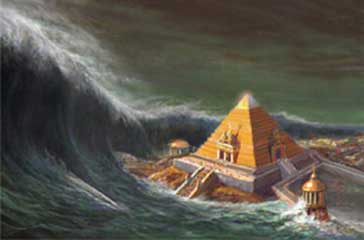
Waves of immigrants from Atlantis who entered the eastern Mediterranean during the geologic upheavals of the late third millennium B.C. were referred to by the Greeks as “Pelasgians.”

LINK

The Origins of Kingship


"So beautiful do you look when you are angry oh Mukunda"
"What happened to your oath not raise weapons in Kurukshetra?"

Clung onto the Lord's feet did Arjuna
Please do not slay the dear Pitamaha (Grandsire)
Both India and China had a concept of a golden age in the remote past that provided a model for later governments and peoples to emulate. This passage from the famous Indian epic known as the Mahabharata describes a three-stage process in the evolution of government in human society. Yudhisthira and Bhishma are two of the main characters in the story.

The Mahabharata Yudhisthira said: ‘‘This word ‘king’ [raja] is so very current in this world, O Bharata; how has it originated? Tell me that, O grandfather.’’

Bhishma said: ‘‘Currently, O best among men, do you listen to everything in its entirety—how kingship originated first during the golden age [krtayuga]. Neither kingship nor king was there in the beginning, neither scepter [danda] nor the bearer of a scepter. All people protected one another by means of righteous conduct, O Bharata, men eventually fell into a state of spiritual lassitude. Then delusion overcame them. Men were thus overpowered by infatuation, O leader of men, on account of the delusion of understanding; their sense of righteous conduct was lost. When understanding was lost, all men, O best of the Bharatas, overpowered by infatuation, became victims of greed. Then they sought to acquire what should not be acquired. Thereby, indeed, O lord, another vice, namely, desire, overcame them. Attachment then attacked them, who had become victims of desire. Attached to objects of sense, they did not discriminate between what should be said and what should not be said, between the edible and inedible and between right and wrong. When this world of men had been submerged in dissipation, all spiritual knowledge [brahman] perished; and when spiritual knowledge perished, O king, righteous conduct also perished.’’

When spiritual knowledge and righteous conduct perished, the gods were overcome with fear, and fearfully sought refuge with Brahma, the creator. Going to the great lord, the ancestor of the worlds, all the gods, afflicted with sorrow, misery, and fear, with folded hands said: ‘‘O Lord, the eternal spiritual knowledge, which had existed in the world of men, has perished because of greed, infatuation, and the like, therefore we have become fearful. Through the loss of spiritual knowledge, righteous conduct also has perished, O God. Therefore, O Lord of the three worlds, mortals have reached a state of indifference. Verily, we showered rain on earth, but mortals showered rain [religious offerings] up to heaven. As a result of the cessation of ritual activity on their part, we faced a serious peril. O grandfather, decide what is most beneficial to use under these circumstances.’’

Then, the self-born lord said to all those gods: ‘‘I will consider what is most beneficial; let your fear depart, O leaders of the gods.’’

Thereupon he composed a work consisting of a hundred thousand chapters out of his own mind, wherein righteous conduct [dharma], as well as material gain [artha] and enjoyment of sensual pleasures [kama] were described. This group, known as the threefold classification of human objectives, was expounded by the self-born lord; so, too, a fourth objective, spiritual emancipation [moksha], which aims at a different goal, and which constitutes a separate group by itself.

Then the gods approached Vishnu, the lord of creatures, and said: ‘‘Indicate to us that one person among mortals who alone is worthy of the highest eminence.’’ Then the blessed lord god Narayana reflected, and brought forth an illustrious mind-born son, called Virajas [who, in this version of the origins of the Indian state, became the first king].